A prop firm is not a broker with a marketing site. It is a rules-compliance contest. You rent buying power. They keep the right to zero the account if one day, one instrument, or one hold time sits outside the contract.
This desk trades liquidity sweeps with a close-based book: wick through a pool is information; the close decides. That mechanic only survives a prop if the firm's rules leave room for the wait, the stand-aside days, and the session that actually prints the raid.
The pairs that show up most on evaluations — and on this site's examples — are XAUUSD (Gold), US100 / NAS100, EURUSD and GBPUSD. Pick the firm for the contract you will actually map, not for a logo.
If you have not fixed risk first, read prop firm risk management: daily loss limit before you pay an evaluation.
You are buying rules, not a logo
Ignore the payout screenshot on the landing page. Score the contract.
A usable firm for a sweep book has five traits:
- A daily loss you can live under with 0.25–0.5R per idea
- A drawdown model that does not punish a runner that is still valid
- Permission to stand aside (news, Friday, bank holidays) without breaking consistency or min-trading-days
- The instruments you actually trade, as the same CFD / future-style print you mapped
- A payout path that does not force trades in the last 48 hours of the month
If any one of those is missing, the evaluation fee is a donation.
The filters that matter
1. Daily loss vs your personal stop
The firm number is not your number.
If the cap is 5%, the survival rule on this desk is a personal daily stop at about half of that. Sweep trading still produces clusters: two failed raids in the same session look like “the market is offered.” That cluster is how accounts die.
Ask:
- Is the daily loss balance or equity (floating)?
- Does it include commissions and swap?
- Does it reset at a clock you do not trade (server midnight vs your session)?
Gold into a US print, or US100 into a cash-open gap, is an equity problem if the cap is marked-to-market tick by tick.
2. Static vs trailing drawdown
This is the clause that kills a valid runner.
- Static / EOD static: the floor is fixed or only updates on closed days. Usable if you let a reclaim develop.
- Intraday trailing (high-water equity): every new peak pulls the death line up. A Gold sweep that delivers +2R then retraces into the order block can take you out while the idea is still valid.
Sweep books need air. Displacement after a raid is not a straight line. If the trail sits tight under equity and you need heat to let the close confirm, the product and the method fight.
Prefer static, or EOD trailing, unless you only scalp closed M1 bars and flatten before any pullback.
3. Consistency, min days, best-day caps
A close-based book is uneven on purpose. Some sessions are A+. Some are stand aside.
Read:
- Max % of profit allowed from a single day
- Minimum trading days
- “You must trade every day” language
If 40% of the target cannot come from one day, a single clean raid on XAUUSD London or US100 NY open that pays 4R becomes a problem, not a win. You will then manufacture trades on dead sessions to “look consistent.” That is how the second week blows the first.
Sweep trading and aggressive consistency caps do not mix.
4. News, Friday, and holds
A sweep book that respects the calendar stands aside on high-impact news, Fridays, and bank holidays. That is a method rule, not a mood.
The firm must not punish it.
Check:
- News trading allowed, restricted, or banned
- Weekend hold allowed
- What happens if you are in a trade into NFP, CPI, FOMC, or a central-bank rate decision
- Whether “news” includes the session open (London FX, NY Gold / US100) — some desks treat the first minutes as a news window
A Judas swing at the open is one such model. If the firm forbids the first 3 or 15 minutes, write the plan: map the raid, wait for the close after the blackout, or skip the open.
Banned news + a sweep model that lives on session liquidity = you pay to sit on your hands, then rush a dead Thursday to hit min days. Price that in before you click pay.
5. Instrument list and the print you mapped
You do not trade “the market.” You trade a specific CFD.
Confirm in the spec, not the ad:
| Book | What to verify |
|---|---|
| XAUUSD | Contract size, spread into NY, whether news spikes widen beyond your stop buffer |
| US100 / NAS100 | Cash-open behaviour, overnight gap rules, commission vs raw spread |
| EURUSD / GBPUSD | Commission + average spread in London; whether min lot still lets you size 0.25R on a small account |
PDH / PDL must be marked on that feed. If the firm's Gold and your map disagree every morning, the “sweep” is a feed artifact.
Also read sessions by asset. A firm built around one product (indices only, or FX only) is the wrong wrapper if your A+ book is the other.
6. EAs, indicators, and hold time
Tools on this desk (Sweep Protocol, Smart Sweep Sniper) do not place orders. They mark closed-bar events.
Still read the fine print:
- Indicators allowed
- Trade copiers / HFT / tick scalping banned (usual, and fine)
- Minimum hold time (30–60 seconds can invalidate a filled M1 rejection)
- Hedging allowed or not
If they ban all custom indicators, you trade a naked book there or you walk.
7. Payout, profit split, and the last-mile trap
A firm you cannot leave is a demo with extra steps.
Score:
- First payout after how many days
- Split on the first tier vs after scale
- Withdrawal fee and method
- Rule changes after you fund (evaluation PDF ≠ funded PDF)
- Country and KYC — rejected after passing means you donated the fee
If payouts are “14 days then maybe,” you will start protecting the number instead of trading the close test. That changes the book.
8. Scaling and account size
Sweep edges are sample-dependent. One pass proves you can follow rules for three weeks. It does not prove the model.
Two small evaluations beat one large vanity account. The blown 100k teaches the same lesson as a 10k, at ten times the emotional cost.
Sweep-specific deal-breakers
Walk away if two or more of these are true:
| Clause | Why it fights a sweep book |
|---|---|
| Intraday trailing drawdown | Retrace after displacement can stop a valid raid |
| Hard news ban + forced daily trades | Stand-aside days become rule violations |
| Best-day cap ≤ 20–25% of target | One A+ Gold or US100 raid becomes “too good” |
| Your pair missing or off-spec | You are not trading the map you built |
| Min hold so long M1 closes are unusable | Rejection entries die in the rulebook |
| Evaluation rules ≠ funded rules | You passed a different game |
None of that is “the firm is a scam.” It is a product mismatch.
A one-page scorecard (print it)
Before you pay:
- Daily loss (firm) _____%. Personal cap I will use _____%.
- Drawdown type: static / EOD trail / intradaily trail.
- News: allowed / window / banned. Friday hold: yes / no.
- Instruments I will trade: Gold / US100 / EURUSD / GBPUSD — listed, spread checked in the real session.
- Consistency cap _____%. Min days _____.
- Indicators allowed. Min hold _____.
- Funded contract read. Payout days _____.
- I can stand aside on news, Friday, and bank holidays without breaking (5) or (3).
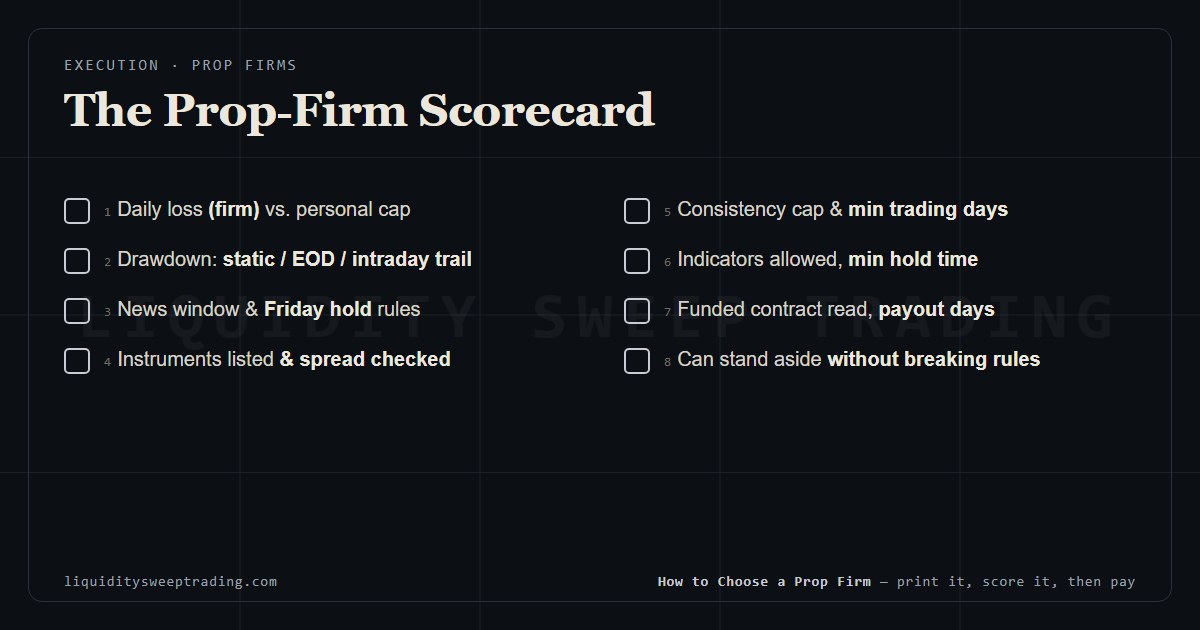
If line 8 is “no,” do not start.
How this desk would use a firm (not a recommendation)
The method does not change because someone else holds the risk:
- Map buy-side / sell-side on that CFD
- Wait for the raid and the close back inside
- No entry once distribution is already underway
- Size in R so 2–3 scratches cannot touch the firm daily loss
The firm is a container. If the container is smaller than the method, shrink the container (smaller account, slower TF) — do not inflate the method.
What this page will not do
It will not rank brands. Rankings expire when the PDF changes on a Sunday night.
It will not tell you a sweep model “passes challenges.” Challenges are small samples. Expectancy needs a sample larger than one evaluation.
It will not treat a payout as proof of skill. Several payouts and many attempts can coexist. That is still a rules problem as much as an edge problem.
Start here
- What is a liquidity sweep
- Daily loss math
- Then the firm PDF — printed, highlighted, scored with the table above
If you need a signal channel to “beat” the evaluation, this is the wrong desk and the wrong firm.
Trading leveraged CFDs and prop evaluations carries a high risk of loss, including the evaluation fee. Nothing on this site is financial advice or a recommendation of any firm. Rules change. Read the current contract. Past charts, challenges and payouts are not future results.
FAQ
Is there a best prop firm for ICT / liquidity sweeps?
No. There is a best fit for your rules: drawdown type, news policy, and the pair you actually map.
Gold, US100 or EURUSD — which is easier to pass with?
None of them is “easier.” Gold moves more per tick; FX needs tighter costs; US100 gaps at the cash open. Demo the session you will trade before you pay.
Can I stand aside on NFP and still pass?
Only if min-days and consistency do not force you to invent trades around the blackout. If they do, the contract fights the book.
Should I use an EA to pass?
Not on this desk. Indicators here mark closes. They do not place orders.