We are happy and proud to introduce The Golden Sweep. It is the most complete tool we have released so far: one sequence read across three timeframes, the bias-timeframe zones drawn for you, the armed setup flagged before anything fires, and a trade plan and an account panel kept on the chart. It is built for gold, it runs on MetaTrader 4 and 5, and it never places an order — see what it draws. What follows is the method it encodes, whether you trade it by hand or let the indicator watch the closes for you.
Gold gives you too many candidates. A sequence is what filters them.
On XAUUSD, the raw ingredients of a smart-money read are everywhere. Any last opposite candle before a push can be labelled an order block. Any three-candle imbalance can be called a fair value gap. Mark them all and the chart stops being a decision tool — it becomes wallpaper.
The fix is not a better pattern. It is an order of operations: decide the side before you look for the entry, and let each step disqualify the next. This guide walks that sequence — a higher-timeframe bias, an order block in that direction, then a confirmation on your own chart — and shows what each step is allowed to tell you, and what it is not.
Step 1 — The bias decides which side you are allowed to take
The first question is not "where do I enter" but "which side am I hunting today". That answer comes from a higher timeframe, read on a closed candle: while a candle is still forming, its body can still change shape, so anything you conclude from it can be revised by the next tick.
Reading a bias from a higher timeframe is standard market-structure work: direction first, then where current price sits inside the range. What the bias buys you is not accuracy — it is elimination. Every setup pointing the other way is discarded before it is ever graded, which removes a whole class of trades you would otherwise argue yourself into.
What the bias is, and is not
- It is: a filter that removes one side of the book for a defined period.
- It is not: a forecast. A bullish bias does not say price will rise; it says you are only shopping for longs while it holds.
- It expires. Tie it to a clock — a session, a day — or it quietly becomes an opinion you defend.
Step 2 — The order block that is allowed to count
An order block is the last opposite candle before a decisive move away from it. The reason it is watched is mechanical: the reading is that a position was built there before price left, so a return to it hands those participants an opportunity to act again — and hands you a level whose invalidation is unambiguous. The full definition and the validation rules are in the order block trading guide.
Two constraints do the filtering here. The first is direction: a block that faces against the bias is not a setup, it is just a candle. The second is proof of departure: a block only earns attention once price leaves it convincingly — displacement, in the vocabulary of the liquidity sweep. Without that, you are marking hesitation, not intent.
What you can read off the chart is the sequence of prices. What you cannot read is who traded and why. "Institutions defended this block" is an inference; "price left this candle quickly and has not traded back through it" is the observation. Build your plan on the second.
Step 3 — Confirmation on your own chart
The bias set the side, the higher-timeframe block set the area. The last step answers "now?". Three confirmations are used on gold, in ascending order of strictness:
- An order block on your chart — the same mechanic as step 2, on the timeframe you actually execute on.
- A fair value gap — the three-candle imbalance, where the push was fast enough to leave unfilled range behind it. Why price can return to it is covered in the fair value gap guide.
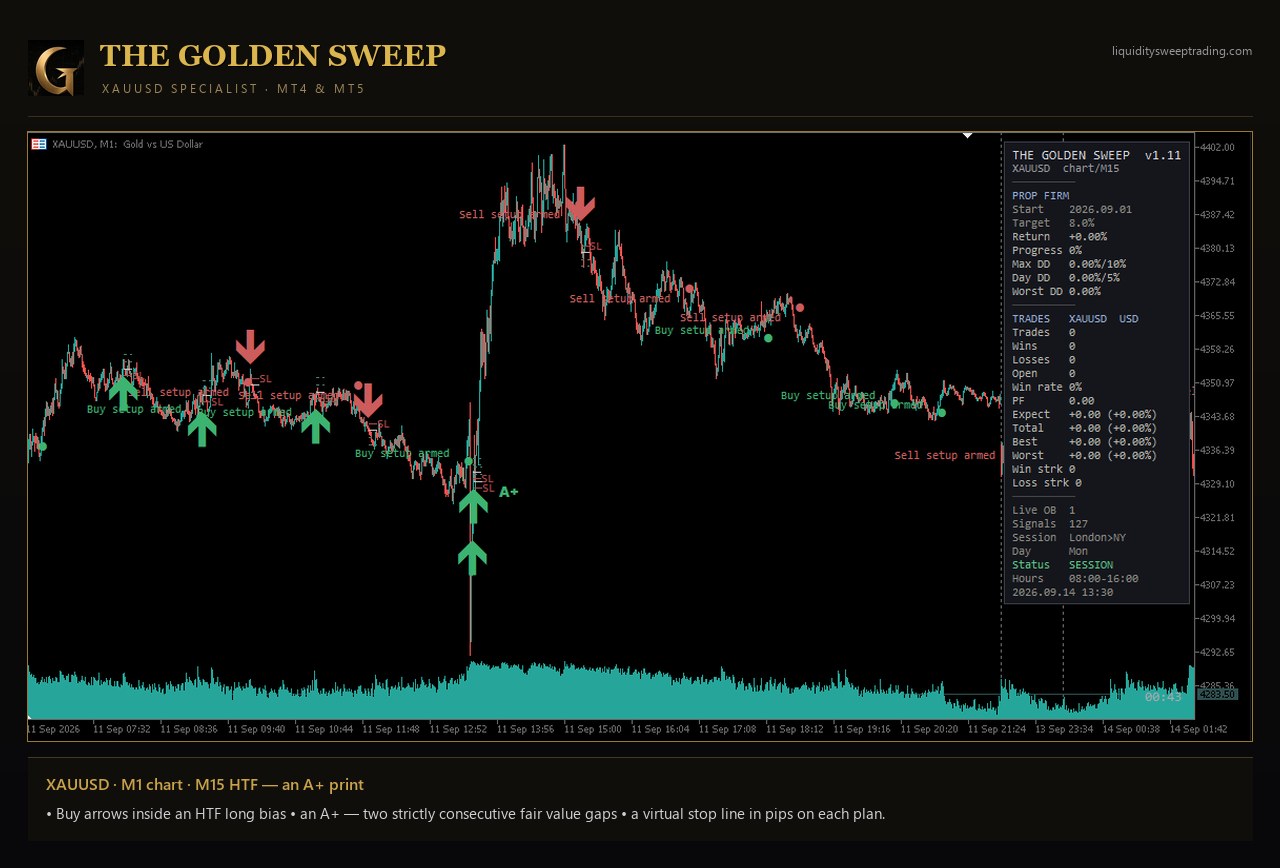
- Two gaps in a row (2FVG) — consecutive imbalances in the same direction. A second gap does not make the first one truer; it tells you the move kept its urgency across more than one candle.
Each of them has to complete on a closed candle. That is the whole discipline: an unclosed candle is a draft, and a signal read from a draft can be rewritten before the bar ends.
Three timeframes, one question each: which side, which area, and has it confirmed yet.
The zones behind the sequence
There is a second, slower way the same three steps can fire. Instead of waiting for a pattern on your execution chart, you can watch the bias timeframe itself: when a fresh order block or fair value gap forms there in the direction you already hold, you have a zone — a rectangle with a mid line — and two obvious moments to act on it. The first is the moment it completes. The second is the first time price comes back to touch it.
Neither is better in the abstract. Acting on completion takes the trade while the move still has momentum and accepts a worse price; waiting for the retest accepts that the touch may never come inside your window. The honest way to choose is to define the window in advance — a fixed number of higher-timeframe candles after the setup arms — and let the clock, not your patience, close the door.
The three rules that keep the sequence honest
- Closed candles only. A level, a gap or a bias read mid-candle can still change. The close is the only version of the test that cannot be revised.
- A session window. Gold behaves differently across Asia, London and New York; a setup that appears in thin hours faces wider spreads and worse fills, which is an execution cost even when the read is right. Match the window to the instrument — see the right trading session for your asset — and remember that the session open is also where the Judas swing model expects a false move that traps early entries.
- A daily reset. Carrying yesterday's bias into a new day means trading a conclusion drawn from a session that has already been settled. Starting the day flat is what makes the rule auditable.
From a signal to a plan you can size
A confirmed sequence is still only a direction and a level. What turns it into a trade is the distance between your entry and the price that proves you wrong, and where you intend to take money off.
Put the stop where the idea fails — beyond the block or the gap that justified the entry — and size the position from that distance, not from a round lot. Express targets as multiples of that same distance so a setup can be compared with any other. If you trade a funded account, the daily loss limit is the constraint that outranks all of this: the arithmetic is in prop firm risk management.
Two cautions belong in the same breath. A stop is an instruction to your broker, not a guarantee: it is filled at the next available price, and on gold during a news release that price can be some distance away. And on leveraged products, losses can exceed the amount you planned to risk on the trade.
Running the sequence without watching every close
Nothing above needs software. It needs you to be at the screen when the higher-timeframe candle closes, again when the block forms, and again when your chart confirms — which, on a fast gold chart across three timeframes, is where consistency is hardest to hold.
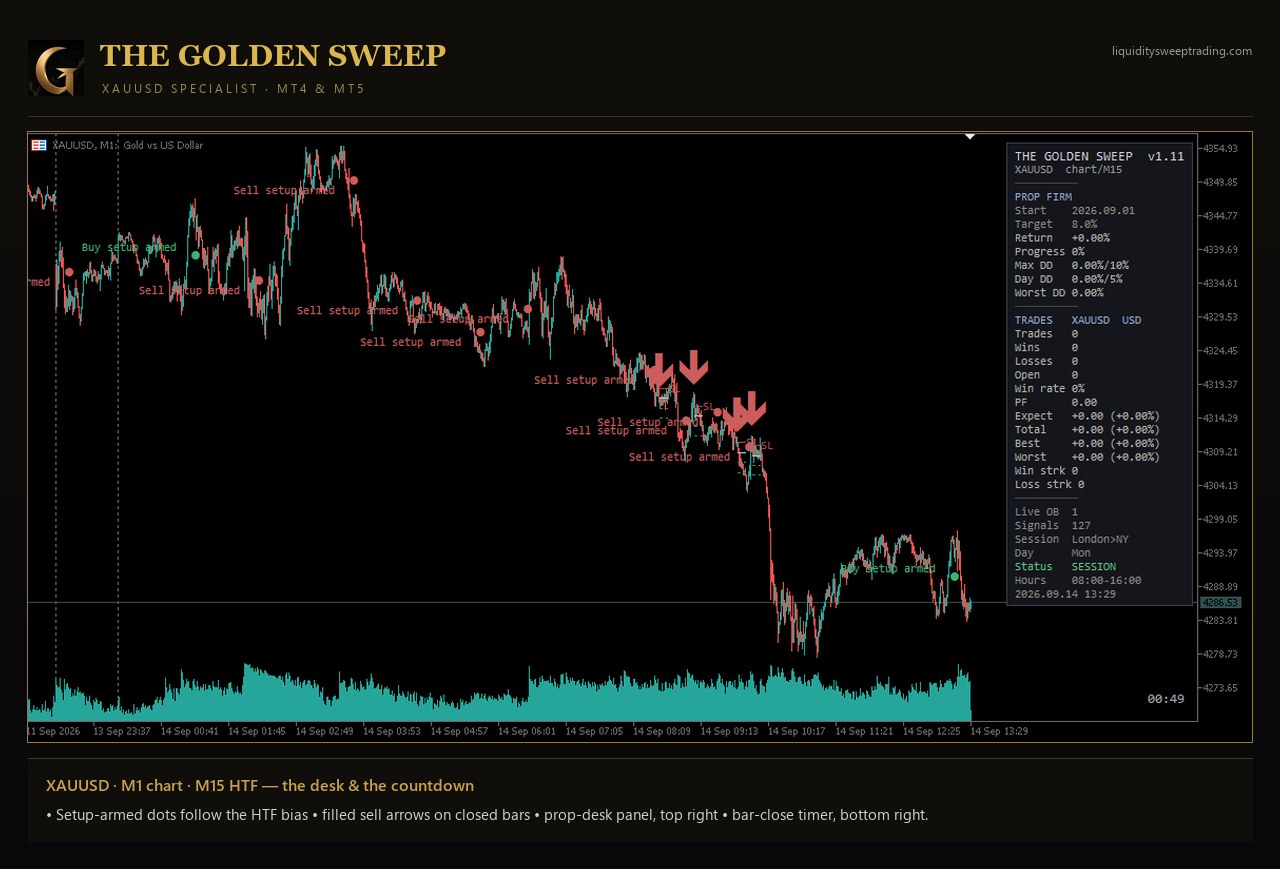
The Golden Sweep is that sequence, encoded for MetaTrader 4 and 5: it flags the armed setup with a dotted line before anything fires, prints the arrow only on the close of the candle that confirms it, draws the bias-timeframe zones with their mid line, and leaves every marker where it printed. It never places an order — the execution decision, and the risk, stay yours.
What this sequence does not do
- It does not read order flow. A block and a gap are price shapes. Who traded there, and in what size, is not visible on a retail chart — that part stays an inference.
- It is not a prediction. A setup that satisfies all three steps can fail on the next candle.
- It does not improve a weak context. Around session opens, scheduled releases and thin hours, levels can be traded through and fills can be worse than planned.
- No recommendation. Nothing here is an instruction to trade a specific instrument or level.